Market Trends - June 2026
A clear overview of the key market developments affecting your supply chain. From raw material price movements and the USD/DKK exchange rate to the latest on carbon and nickel. We believe you deserve full transparency on the forces shaping our pricing.
Nickel (LME)
19,235
USD/T
▲ +15% YTD 2026
Carbon material idx
3,035
USD/T
▲ +4.7% YTD 2026
USD / DKK
6.4153
DKK per 1 USD
▲ USD strengthening
USD / CNY
6.7684
CNY per 1 USD
▼ Yuan strengthening
Carbon Flanges & Fittings
Rising
Cost pressure
▲ Steel + USD impact
Raw Materials
Commodity Price Developments
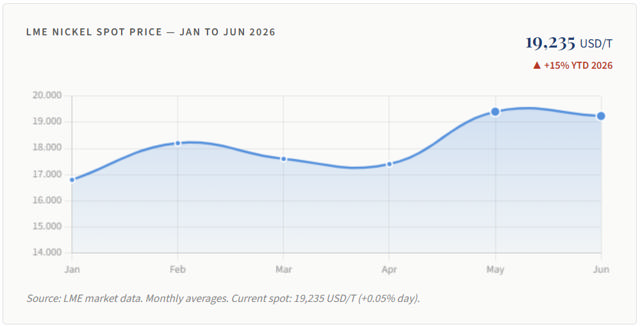
Nickel — LME Spot Price
Nickel opened January 2026 at approximately USD 16,800/T and has climbed steadily since. After a brief consolidation in February and March around USD 17,500–18,200, prices accelerated sharply through April and May, reaching a year-to-date high above USD 19,400/T before settling at the current level of USD 19,235/T. That represents a rise of nearly 15% since the start of 2026. Constrained Indonesian mining output and sustained speculative demand continue to underpin elevated prices.
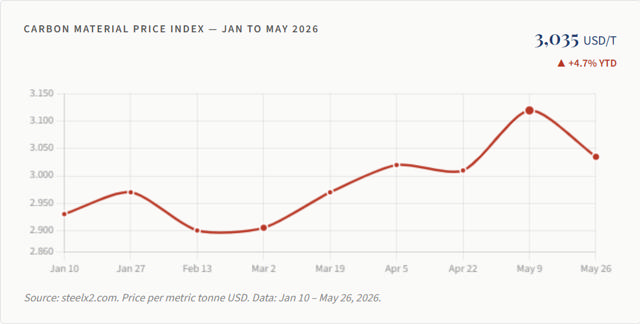
Carbon Material Index
Carbon material prices opened 2026 at approximately USD 2,930/T, briefly dipped toward USD 2,880 in mid-February, then climbed steadily through March and April. The index peaked above USD 3,100/T in early May before correcting to the current level near USD 3,035/T. The upward trend is supported by stable mill order books & higher scrap costs.
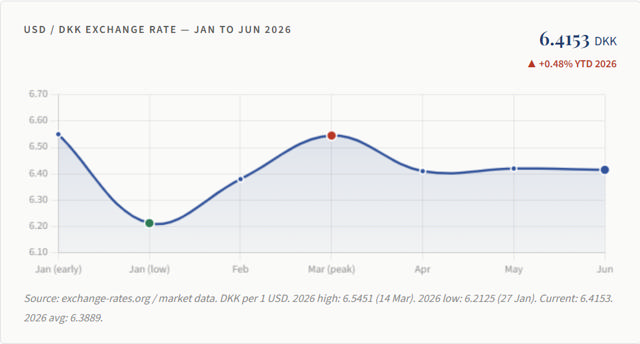
USD / DKK Exchange Rate
As a Danish company purchasing raw materials priced in US Dollars, the USD/DKK exchange rate is a direct cost driver for INDURA. The chart below illustrates how the rate has developed since January 2026. The dollar opened the year strongly at around 6.55 DKK, then weakened sharply to a year low of 6.2125 DKK on 27 January. It recovered through February and surged to a year high of 6.5451 DKK on 14 March, before gradually softening to the current level of 6.4153 DKK.
This means that compared to January's low of 6.2125, today's rate of 6.4153 represents a cost increase of approximately 3.3% on all USD-denominated purchases — directly impacting across our full range of USD-priced products, including nickel alloys and carbon material.
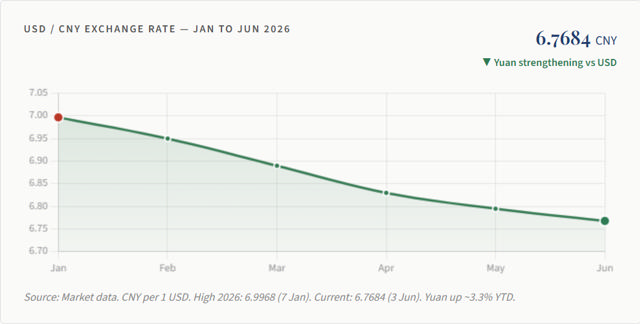
USD / CNY Exchange Rate
The USD/CNY rate is a key indicator for the cost of goods sourced from Chinese manufacturers — including Asian-origin carbon fittings and flanges. In 2026, the Chinese yuan has strengthened against the US dollar, with the rate falling from a January high of 6.9968 CNY per USD down to the current level of 6.7684 CNY — a yuan appreciation of approximately 3.3% year-to-date.
A stronger yuan means Chinese production costs effectively rise in dollar terms, reducing the price advantage of Asian-origin products and adding upward pressure to import prices. This dynamic directly affects the competitiveness of Asian-sourced fittings and flanges relative to European alternatives.
LOGISTICS
Sea Freight Import - Asia to North Europe
Freight rates continue to rise — and this time markedly — driven by a combination of increasing oil costs and geopolitical uncertainty. In addition, many importers are advancing their shipments to secure supply flow in an uncertain period, pushing up demand. This is translating into a range of surcharges from shipping lines, which are driving rates higher.
Bookings must be placed a minimum of 4 weeks before cargo is ready. This is necessary to secure the required capacity with carriers during a period of significantly elevated demand.
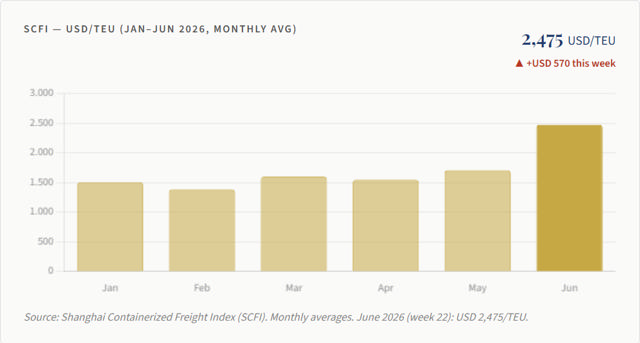
The rising rates are reflected in today's SCFI figure, which has increased by USD 570/TEU, landing at USD 2,475/TEU — the highest level recorded in the data series shown below.
Road Freight
Road Transport in Europe
The European road freight market continues to be characterised by reasonable capacity and stable delivery times to most destinations. At the same time, the transport industry is experiencing rising costs due to higher diesel prices, increased road tolls, and generally rising operating costs.
Although the capacity situation is currently stable, the market remains affected by driver shortages in several parts of Europe, which limits flexibility among carriers.
For our customers, this means we can continue to ensure stable deliveries to most European markets — however, transport costs remain under pressure in the period ahead.
Product Updates
Flanges - Market Position
Carbon Flanges — Raw Material & Pricing Outlook
Steel raw material prices for carbon flanges dipped below USD 3,000/T last quarter — briefly falling under 2,900 — but have since rebounded sharply, crossing back above 3,100 before retreating slightly to the current level of approximately USD 3,010/T. The recent two-week softening introduces some uncertainty, but the broader trend remains upward.
Suppliers are signalling continued price increases in the coming period, though at a moderate pace. There are no indications of sudden or large-scale price movements — the outlook points to a reasonably stable level with a modest upward bias.
Mill production times are stable and we do not expect to see any significant changes here in the future.
Stainless Flanges - Pricing Outlook
Continued upward price pressure is expected on stainless flanges in the coming period. Suppliers are pointing in particular to constraints in nickel mining in Indonesia as a key driver behind the anticipated price increases — directly feeding into higher alloy surcharges on stainless grades including 1.4404, and 1.4571.
On a positive note, producers are maintaining normal production lead times, meaning delivery schedules remain stable despite the cost pressure. Availability is not a concern at this stage — the impact is primarily felt on the price side.
Product Updates
Fittings - Market Position
Carbon Fittings — EU Origin
European-manufactured carbon fittings benefit from shorter lead times. Mill order books in Europe are firming as demand recovers.
Prices from European suppliers have been stable for several years. Our EU partners have maintained steady pricing, but have now signalled upcoming price increases. Increases of 5–10% are indicated, though final rates have not yet been confirmed. The overall indication is a rising price level for EU origin Buttweld fittings in the period ahead.
Carbon Fittings — Asia Origin
Prices from Asian suppliers have generally been stable over the past quarter. The primary challenge has been high minimum order quantities (MOQ) on niche products, leading to sourcing across multiple suppliers and wider price variation.
Freight from Asia represents a significant share of the total product cost, as containers often carry a large proportion of air due to the bulky nature of fittings. Given the current rise in freight rates, this is expected to be reflected in prices going forward.
A new gross pricelist will be implemented to reflect these changes.
We have worked to absorb a portion of these cost increases internally. However, the concurrent nature of these pressures — commodity prices, currency movements, and supply chain dynamics all shifting simultaneously — makes full absorption unsustainable across the product range.
Mill production times are stable and we do not expect to see any significant changes here in the future.